7 Amazingly Effective Arm Slimming Exercises for Women

Triceps, when properly weight-trained, make up two-thirds of your upper arm's overall size. 

As such, it's better to do a quick triceps workout than to skip it when your gym time is tight. If it's absolutely necessary to skip a body-part when training arms, better you should skip biceps than triceps if you're looking to develop upper arm muscle mass.

Your triceps brachii muscles have 3 heads - the long head, medial head and lateral head. They run down the back of your upper arm, from shoulder to elbow, and are mostly involved in extending your elbow to straighten your arm. 

The concentric portion of each rep contracts your triceps and fully straightens your arms, while the eccentric portion lowers the weight by allowing the elbow to bend to 90 degrees or more.

While twice the size of your biceps, the triceps are still one of the smaller bodyparts and can recover more quickly that larger muscle groups like legs, back and chest. 

This means you can work your triceps 2 - 3 times per week on non-consecutive days, but be careful not to use heavier weights than you can manage with proper form to prevent damaging your elbow ligaments or joint.

If you're training time is limited during a workout, use these three exercises to work the triceps, doing 3 or 4 sets of 10 reps each. Don't rush the reps - use a cadence of 1 second up and 3 seconds down with no pause or rest at the top or bottom of each movement.

Lying Triceps Extensions 
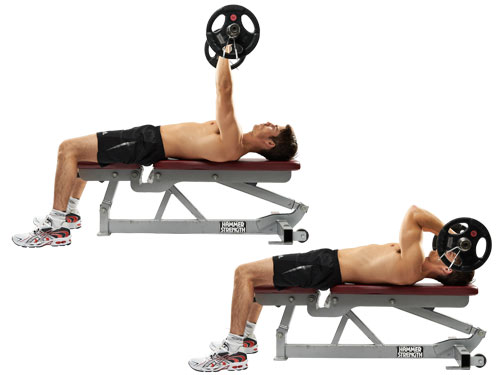

Also known as 'skull-crushers', lying triceps extensions start with you lying flat on the bench with your arms straight up above you, perpendicular to your body. 


The exercise can be done with dumbbells, a straight bar, a cambered (EZ curl) bar or the specialized triceps bar. 


Start by slowly lowering the weight to your forehead then return it back to the top position at a faster speed. At the end of each set, go immediately into the next exercise with no break.

Narrow-Grip Bench Press 

The second half of this triceps superset is the narrow-grip bench press. 

If you're using a triceps bar then you'll automatically have a narrow grip already, but if not then be sure your grip is about shoulder width or a touch narrower. 

Going any narrower than that places too much strain on the wrists at the bottom of the movement, so if you find your wrists getting sore widen your grip slightly. Since you're already lying on the bench in the proper position, lower the weights to your chest while keeping your elbows tucked close to your body, then raise the weight directly up by extending your arms. 

Do not let your elbows drift out to the sides as this involves the pectoral muscles of the chest more than you want it to - keep the tension on your triceps as the weight moves up and down.

Because you're supersetting this press with the extensions the weight won't be as heavy as you could do otherwise, so you can compensate by either doing a few more reps per set or slowing each rep down, especially on the eccentric (lowering) portion of each rep.

At the end of your set rest for about a minute, then go back to the lying extensions to begin your next set. Perform the full cycle 3 - 4 times before moving on to the third exercise.

Overhead Triceps Extensions 

Sit up on your bench with your feet flat on the floor and a neutral or slightly-arched lower back. 

Using two hands, suspend a dumbbell overhead so that it rests perpendicular to the floor - your thumbs and forefingers should be wrapped around the handle while your palms and other fingers are pressed against the underside of the top bell to support the weight.

Keeping your elbows facing forward and tucked close to the sides of your head, bend your elbows and slowly lower the weight as far down as you can behind your head, then return the weight back up to directly overhead. 

Your upper arms should not move during the exercise but instead stay upright and close to your head.


Other Triceps Exercises 

The three exercises above will give you quick tricep workouts that are effective in building more muscle, but if you need to replace any of them due to injury or other physical issues, replace the necessary exercise with dumbbell kickbacks. 

Kickbacks have been shown to stimulate all 3 heads during each rep, so it's your best replacement exercise. 

Other triceps exercises like pushdowns, rope pushdowns, overhead cable extensions and triceps dips are good too, but save them for your workouts where time isn't limited and you can fit one or more of them in with these three.


Bigger biceps are a status symbol, a symbol of personal physical power, and every bodybuilder spends a fair amount of time working to achieve the best biceps they can build. Unfortunately time isn't always on our side, so for some workouts we need a quick bicep routine like this one...

Now, we don't want to take a lot of time, but we don't want to waste what little time we have either, right? So do a quick warmup set of curls if you haven't already warmed up your biceps while training other body parts. 

Don't overdo it - one set of 10 - 15 reps should suffice to get blood into the muscles and loosen up the joints, tendons and ligaments. Now choose a pair of dumbbells you can manage safely for 10 or 12 reps with strict form.

Note that these aren't reps you can cheat up with plenty of momentum and 'body English', but rather good, strict reps at a temp of 1 second up (concentric) and 3 - 5 seconds down (eccentric). 

For 2 of these 3 exercises you'll be taking body motion out of the equation entirely, so you need to choose weights that are challenging but manageable.

Do each of these three biceps exercises for 3 - 5 sets (depending on your available time), with 10 - 12 reps per set. Focus on keeping to your tempo, not trying to race through each set.

Incline Dumbbell Curls

Set the back of your bench to a 30 - 45 degree angle, then sit on the bench laying back against it with the dumbbells hanging at each side. 

Perform your curls through the full range of motion, finishing a full rep with one arm before repeating with the opposite arm. 

Keep your body flat on the bench throughout and don't let your elbows travel forward as you raise and lower the weights.

Dumbbell Scott Curls or Dumbbell Preacher Curls

Depending on the equipment you have available, you can do these as Scott curls or preacher curls. 

If neither bench is available, you can also stand behind an incline bench and rest the back of your upper arm down the padded back. 

Use a sitting or standing position that has you leaning forward from the waist with your armpit snug to the top of the pad. 

Resist the urge to lean backward as you raise the weights - the reason you're using the bench is to prevent yourself from 'cheating' the rep by involving your bodyweight. 

Curl the weight to the top, squeeze your contracted biceps hard for a second or two and then return it, under control, to the extended position.

Standing Dumbbell Curls

To finish off this quick bicep workout, use standing dumbbell curls. On the first exercise your elbow was behind the plane of your body while on the second it was ahead of your body, and this time you'll keep your elbows at your sides. 

Raise the weights one arm at a time, pronating your wrist at the top, rotating it to bring your baby finger closest to your chest & shoulder, before lowering it again at a controlled pace. Do not just let it drop back down, stick to the 3 - 5 second pace.

By the end of this quick bicep workout you should be able to tell the muscles have been well-worked, and flexing them should reflect a good pump. 

If timing is too tight even for this short routine, you can shorten it even further by doing one set of each exercise with no breaks in between, resting for one minute and then repeating the 3 sets until you've done your 3 - 5 cycles.

Either way, re-rack your dumbbells and smile - your biceps know they've had a great, fast workout!

By   

IS DIETING THE KEY TO LOSE WEIGHT?

You see a lot of articles in magazines and online about exercising to burn off excess bodyfat and yes, it does help. But it's not the only, nor even the best way to lose fat. To reduce bodyfat you need to be in a calorie deficit, and following a healthy diet is your most powerful weapon in that battle for a number of reasons...

First, let's quickly look at the physics involved. Calories are a measure of stored energy contained to varying degrees within each type of food, and when ingested it takes 3,500 calories to add one pound of body-weight. 

Your body uses some calories every day for internal functions, plus to power you through your daily activities. If you consume fewer calories than needed, your body converts some of its stored calories to make up the difference. 

If you feed it more calories than it burns, it will store the extra as fat to keep those calories available when food becomes scarce.

The best way to burn fat is a combination of calorie restriction and exercise, to hit the problem from both fronts. So why is lowering your caloric intake more effective than exercise for burning fat? Because the main purpose of exercising is to build strength, muscle and endurance, not burn fat. 
At best, an hour on a treadmill each day will burn about 500 calories an hour or less, depending on your bodyweight, the speed and the angle of incline. Over the course of a week, if you run for an hour every day you've burned 3,500 calories - one pound's worth of fat. 

Unfortunately most people will find the energy expenditure leads them to eat more, negating the effects. 

This explains why you see the same people using the treadmills in the gym year after year with little or no impact on their bodyfat levels.

But what about lifting weights? Weightlifting builds muscle, and muscle burns calories 24 hours a day, right? Yes - each pound of lean muscle you have burns about half a calorie per hour, 24/7. 

But that's just 12 calories per day - 10 extra pounds of muscle will only burn off a pound or so of fat per month. And once again, this often means an increase in appetite to go with the efforts required to build that extra 10 pounds of muscle.

So while exercise IS a part of the overall picture, both for optimal health and for burning bodyfat, the biggest gains can be made by EFFECTIVELY managing your calories through a healthy nutrition plan. Note the emphasis on 'effectively' managing your calories - simply cutting way back in your daily calories is dangerous and counter-productive. 
Your body will go into 'starvation mode' if you suddenly stop eating for an extended period and will react by slowing your metabolism down drastically, thwarting your efforts to burn body-fat.

While every body is different and each person's metabolism is different, start with this general rate: daily caloric intake for men should start at about 12 calories per pound of body-weight, while for women it should be 10 calories per pound. 

Pick a reasonable body-weight goal for your height and gender and use that as your starting point. So if a man wants to burn fat and get down to 175 pounds, he wants to start at 2,100 calories per day. A woman wanting to get back to 120 pounds would start consuming 1,200 calories per day.

Give that level a few weeks to see what effect it has on your bodyfat levels, then tweak it a bit up or down as necessary to reach, and maintain your goals. No, you won't lose fat as quickly as on some of the better fad diets, but you'll lose it safely while learning to maintain the new weight and avoid the yo-yo dieting cycle so many are trapped in.

Pay attention to WHAT you eat as well, not just how much you eat. Carbohydrates are converted to glucose in the liver and then transported through your body by insulin from your pancreas - too many carbs makes your body produce that much more insulin to try and control your blood sugar levels, and if the extra glucose isn't absorbed by your muscles it WILL be by your fat cells. 
Don't avoid carbs either, though - you need a balance of all 3 macro-nutrients - carbs, protein and healthy fats. Instead opt for healthier carb sources like rolled oats instead of sugary cereals, sweet potatoes instead of white potatoes and have extra vegetables like broccoli and Brussels sprouts when you're hungrier. 

For snacks, have an apple or an orange instead of chips or chocolate bars.

By following a healthy diet and making exercise a regular part of your weekly routine you can hit your goal weight, get rid of the excess body-fat and maintain the healthy weight that's just right for YOU. And you'll be helping to stave off or reduce the severity of type-2 diabetes, heart attacks and strokes. Don't put it off - get started on your own healthy nutrition lifestyle right away!
Article Source: http://EzineArticles.com/8616525

ARE YOU READY TO GET BACK IN SHAPE?

Are you ready to get back in shape? If you're like most adults, you've been flirting with fitness for years; getting into reasonable shape then letting it slide until you're finally bothered enough to do something about it again. But to get - and stay - in shape you need to break that cycle and move towards living a healthy lifestyle.

To truly move towards a healthy lifestyle usually means addressing health concerns in a number of areas. 

First, you need to schedule a full physical & blood workup with your doctor, if only to be sure of what conditions and concerns you need to allow for as you get started. 
Changing your diet, sleep patterns and exercise level places some stresses on your system initially, even if those changes are designed to bring you better health over time.

Discuss your planned return to fitness with your doctor while you're there. While your doctor may not know as much about exercise physiology as your personal trainer or as much about current nutrition research as your registered nutritionist, he or she knows a lot more about YOUR body and systems than anyone else. 

While you might never get your doctor to create my exercise plan or design your meal plan, you should never ignore their advice regarding your body and it's internal workings - that would just be foolish and potentially dangerous.

Once your licensed medical professional has given you the green light to start working out and changing dietary habits, be prudent about getting started and especially realistic in your expectations. 
Chances are you didn't get out of shape in just a few weeks or months, so don't expect to reverse the damage and get in shape in that short a time period. 

For one thing, the loftier your goals and shorter your expected time to achieve that level of fitness, the greater the risk you'll do more damage than good.

For example, when trying to get back in shape many people will pick up one or two bodybuilding magazines, find the workout routines competitive bodybuilders are using, and try to start out with those. 

After all, if it worked that well for them then it has to do the same for you, right? WRONG. 
The pro bodybuilders featured in most magazines have: 

a) been working out for years, building up to a point where their bodies can handle a workout like that.

b) most pro bodybuilders are using thousands of dollars a month in steroids and other drugs to help their bodies heal faster and stronger-without those drugs even they would have to dial their workouts down a few notches... 

And their central nervous system is already used to those heavy weights and grueling workouts - think of what they'd do to YOUR body!

To truly get in shape and stay in shape, don't even consider using drugs to get bigger, get stronger or lose weight. Fitness isn't a cosmetic concept - those sexy bodies with their healthy glow are a side effect of being in great shape. Fitness is a health issue, and using illicit drugs to reach certain goals quicker is counter-intuitive to being as healthy as you can be.

Besides, unless you have a life-threatening condition or are morbidly obese, you most likely have a lot of time to get in shape. 

Trying to achieve a great fitness level or that 'perfect' body too quickly will lead to disappointments that will quickly erode your motivation and probably result in you abandoning your quest yet again.
Instead of starting out with the goal of losing 30 pounds, benching 250 pounds or running the next marathon, set your goals to be a little better each week than the week before. Start each week with the goal to lose 1 - 2 pounds, add 5 pounds to your bench press or run a quarter mile farther than you did last week.

Setting reasonable goals will still have you reaching to achieve them each week while giving you a greater chance of success - success that will help you stay motivated to get in better shape week after week.

And while you won't meet or exceed your goals every single week, your overall patter of success will lead you further and further along your path to a truly healthy lifestyle and the resultant fitness, energy and health benefits.


Article Source: http://EzineArticles.com/7085412