Showing posts with label Programs. Show all posts

It’s still better to be fat and fit than thin and unfit

As a new year begins, people flock to diets like lemmings to cliff edges. The bad news: Some 95% of those diets will fail in the long run, and many of us will wind up heavier and less healthy than when we started.

But there’s good news, too: Fitness may be even more important to your health than weight is. And fitness is something you can improve regardless of the number on the scale.

The latest in a series of studies by researchers at the Cooper Institute in Dallas, as well as a meta-analysis  of other studies, have found that people with higher levels of cardio respiratory fitness (a measure of how much oxygen your body uses during exercise) have less chance of early death than those with lower levels, even if they are considered overweight or obese. And it’s way better, healthwise, to be fat and fit than to be thin and unfit. “If you’re fit, it nullifies the apparent risk of high waist circumference or obesity,” says Paul McAuley, a professor of exercise science at the University of South Carolina. “Fitness is a powerful indicator of physical health.”

If this is true, why aren’t we hearing about it? One reason is that researchers, like the rest of us, are still entrenched in the “fat will kill you” mindset, and interpret their findings accordingly. For instance, pretty much all the research on weight loss involves some kind of change in lifestyle, often in the form of exercise. 

But researchers tend to attribute better health or lower mortality only to the weight lost, especially if those in the study drop from the “obese” or “overweight” categories into the “normal” one. They fail to explore the idea that it might be the exercise (and the better fitness that results) that makes the difference, rather than the weight itself.

Another reason is that many of the studies on weight and health don’t even ask participants about their fitness levels, let alone measure them. “Every week, in leading scientific medical journals around the world, I can see a finding on obesity and health condition X or Y,” grumbles Steven Blair, a professor of exercise science and epidemiology at the University of South Carolina. “I type in ‘physical activity’ and get ‘term not found.’ That is junk science. You cannot study health and weight without taking physical activity into account.”

Some experts believe that fitness accounts for some of the more puzzling findings on weight and health, like the so-called obesity paradox: that, among sufferers of chronic diseases like type 2 diabetes and heart disease, fatter people fare better and live longer than thinner ones. 

“Fitness seems to mitigate the relationship between fatness and [disease] prognosis,” says Carl Lavie, M.D., medical director of the Ochsner Heart and Vascular Institute in New Orleans. “It looks like it’s more important to maintain your fitness than your leanness.”

We still don’t fully understand exactly how fitness, weight, and health interact. But it’s clear that fitness is a crucial aspect of good health. So this year, resist the temptation to put yourself on a futile and potentially damaging diet, and find ways to get a little more active instead.

10 Quick Tips to Help You Stick to Your Goals

New Year's "resolutions" are often made at the beginning of the year. We resolve to exercise more, eat healthier, pursue career aspirations, spend less time online, or work on our relationships. 

However, the truth is one in three people abandon their resolutions by the end of January -- citing lack of time or commitment to the goals to begin with.

If you are serious about sticking to your resolutions, there are some solid methods that may increase your chances for success.

Change is never easy -- it requires soul-searching and resolve -- but the results of working toward positive transformation can offer you renewed confidence and a more purposeful outlook for the future.

Consider these ten tips to help you establish, achieve and maintain your objectives:

1. Set SMART goals.

The most critical component of sticking to a resolution is setting it. SMART is an acronym for Specific, Measurable, Attainable, Realistic and Time-bound. For instance, "I want to lose weight" is not a goal -- "I want to lose 10 pounds by March" is more specific, measurable and incorporates a deadline.

2. Write down your goals.

This will force you to clarify what you want and motivate you to take action. A study from the Dominican University of California found that people who wrote down their goals, shared this information with a friend, and sent weekly updates to them were on average 33 percent more successful in accomplishing their stated goals than those who merely formulated goals on their own.

3. Take notes when you give in to an addictive behavior.

Try to maintain an open, non-judgmental attitude by being an insightful and attentive "witness" to your actions. This will help you identify your triggers so you will be more aware of the emotions attached to the behavior. A willingness to looking at the "why" behind your actions will provide insight and assist you in conquering the habit.

4. No goal can be met without motivation.

Take time to define why you want to lose weight, mend a relationship or cut down on alcohol. Write down your reasons for changing the habit or behavior, and then create recurring reminders in the form of notes -- placed on the bathroom mirror, in your car, or on the fridge. Alternatively, you can create calendar events or a voicemail recording to remind you of why you want to initiate the change.

5. Block out time.

Lack of time can serve as a perpetual excuse for us all. In order to realistically set yourself up for success you have to determine how much time you will need to devote to attaining your goal and schedule it on your calendar each week so you aren't tempted to double-book.

6. Know your weaknesses.

Identify your triggers. Try to determine what throws you off course. Does stress provoke you to have a drink or to smoke? Do you binge eat at lunch if you skip breakfast? Take a good look at your behavior and identify what causes you to slip up -- then find ways to prevent self-sabotage.

7. Don't do it alone.

Find someone you trust and ask them to support you through the process, making you more accountable.

8. Try mindful meditation and breathing techniques.

Meditation and becoming more mindful can help reveal why cravings and addictive behaviors arise and may allow you to make changes with more ease.

9. Reward yourself.

Celebrate your successes (with something that's good for you) for sticking to your new, healthier behaviors.

10. Surround yourself with like-minded people.

Try to spend more time with those who share the same aspirations and long-term objectives. Seek out others who are intent on making positive changes in their own lives -- and encourage you to do the same.


5 ways you’re sabotaging your weight-loss resolutions

This week, nearly half of all Americans will resolve to make 2016 the year they get fitter, faster and reach their feel-great weights. Indeed, weight loss and exercising continue to be among the most popular New Year’s vows, according to a Marist Poll.

It would be wonderful if the pounds melted off as soon as we ramped up our workouts and swore off sweets.

But many people find that weight loss isn’t that simple or that linear.
They get stuck in a weight-watching purgatory — dragging themselves through workouts and scrutinizing food labels — while the numbers on the bathroom scale stall or inch upward.

“I hear people say this all the time,” says Tom McGlynn, founder of Runcoach, which trains 1,500 area runners annually for the Marine Corps Marathon, Historic Half Marathon and Cherry Blossom 10-Miler.

To be sure, some of the initial weight gain is often due to water retention, says Jim White, a Virginia Beach-based dietitian and exercise physiologist.

When you lift weights or run up a hill, the muscle fibers tear. The body responds by producing fluids full of white blood cells and nutrients to heal those fibers so you get stronger, says White.

But for more people, the forces that drive the weight gain are much more complex. Here are some common weight-loss traps and how to avoid them.

You do too much too soon

Many people try to overhaul their diets while simultaneously logging monster workout sessions at a pace that’s unsustainable. “People get all excited about counting calories, they overexercise and undereat, and it ends up being too much restriction,” says exercise physiologist Jenny Hadfield, founder of coachjenny.com. 

“Three weeks after they start, they can’t manage it, and the scale tips the other way.” Without adequate fueling, workouts become a waste of time; with no energy to push their bodies faster, harder and longer, people can’t make substantial fitness gains.

And the body rebels, Hadfield says. “When we drastically reduce calorie consumption and combine that with higher levels of exercise, the body adapts by lowering our metabolic rates.” So you may drop pounds at first, but eventually you regain the weight, and then some. And there’s new evidence that excess restriction messes with the body’s hunger mechanism. 

 In a study published in the December 2015 issue of eLife, when rats’ meal times were limited, levels of the fullness hormone ghrelin plummeted and they ate twice as much.

Hadfield says baby steps are often more effective. With exercise, do a variety of workouts: short easy aerobic efforts, endurance-building long sessions, strength and cross-training. And make one to two small dietary changes at a time. 

Give yourslf time to adjust to each change before making another. “Even just a glass of wine can be the difference between maintaining and losing weight,” says White. 

But don’t get rid of the pre-workout nosh. White recommends eating a snack of 100 calories 30 minutes before exercise — say a piece of fruit, a cup of yogurt or half a granola bar. “You just don’t want to be hungry, as that can cause you to be weak,” he says. 

Experiment with different foods to figure out what gives you a boost without upsetting your stomach.

You adopt a diet off the shelf

Many people hitch their weight-loss hopes to a popular diet, declaring themselves low-carb, Paleo, or gluten-free without considering their own likes and lifestyles. 

If a diet requires consuming specialty foods that drain your wallet or make you feel chronically deprived, it isn’t likely to last. “One-size-fits-all programs can be effective in the short term,” says White, “but they can be too hard to follow and people often end up gaining weight back.” 

Adopt an eating plan that you can afford and enjoy. And allow yourself a weekly treat meal. Just don’t regard it as a “cheat” meal, White warns, which perpetuates a fear-based attitude about food. 

Indeed, research suggests that the idea of cheating can derail your diet. In a study published in the March 2014 issue of Appetite, people who associated chocolate cake with guilt reported less control over eating and were less successful at weight loss compared to those who associated the cake with celebration.

Your eating and exercise habits don’t work

Any diet must support your exercise routine so you get adequate amounts of nutrients. Coaches say they see a lot of people attempting low-carb diets while training for endurance events like marathons, which often backfires. 

Carbs are the nutrient the body can most efficiently convert into energy. So trying to exercise without carbs “is like trying to drive your car with zero gas,” says White. “People go to exercise, they have no energy, they hate it and get discouraged.” 

Once you pick a workout routine or a sports goal, meet with a dietitian to customize an eating plan that will complement it.

You go overboard with the energy bars

Grocery shelves are packed with sports bars that promise to deliver speed, strength and energy. Snack, nutrition and protein bars have become a $6.2 billion market, according to Mintel, the Chicago research firm. And sales of performance bars geared to enhancing fitness and exercise have skyrocketed by 83% since 2009. 

Many of these products have calorie, sugar and fat profiles that rival conventional candy bars. Though these foods are designed for refueling during workouts of 60 minutes or longer, many people go overboard once they start working out. “People eat those products and figure ‘that wasn’t real food, now I have to go get a real meal,’ ” says McGlynn. 

“Meanwhile they just ate 500 calories.” He encourages clients to focus on fruits, vegetables and grains for carbs; poultry, fish and lean red meat for protein; and nuts and avocados for fats. 

“Spend the calories on natural foods that we know have vitamins and nutrients that are beneficial,” he says.

You overcompensate for calorie burn

Many people find that the more they exercise, the more they eat, either because the increased activity makes them hungrier or because they feel entitled to a donut after a tough workout. 

In a study published in the May 2014 issue of Marketing Letters, people who were told a two-kilometer walk was exercise ate 35 percent more chocolate pudding afterward than those who thought the same stroll was a “scenic walk.” And it takes only minutes to eat back the calories burned on a 30-minute run. 

To avoid this, before your workout, prepare a post-workout snack that you can grab when you return — say some fat-free Greek yogurt and a piece of fruit, or some rice cakes with peanut butter. And find ways to make your calorie burn fun. Meet a friend for a run so your workout becomes a social hour. 

Download audiobooks and reserve your exercise time for entertainment. Most important, find a form of exercise that you genuinely enjoy. If you dread it, you’re not going to do it.


5 WAYS TO AVOID HOLIDAY WEIGHT GAIN

It's that time of year when each calories lurks like a pro boxer and tries to punch you from every angle possible – eggnog, cookies, wine jelly doughnuts and all kinds of chocolate. 

All these delicious foods add up whether you like it or not, and your body can't help it but putting on a some extra fat by New Year's Day.

Gaining a lit but of extra weight may sound harmful especially if its just a pound or two٫ However, according to researchers at the National Institutes of Health, most Americans never lose the weight they gain during the winter holidays. 

The extra weight adds up year after year, making holiday weight gain an important factor in adult obesity.

Hence don't fall into this trap. It is possible to enjoy holiday goodies without putting on any undesirable extra weight.


The following 5 tips will help your control your weight gain during holidays, it is not guaranteed to not gain any weight but it will make it as low as possible:

1.Never Go to Parties Hungry

The most common mistake is taking an excess portion of high-fat pastries, chips and dips while waiting for the "real" food to arrive. 

Avoid overeating at family reunions, events and parties by ensuring you do not arrive at an event starving. 

Eat a healthy snack 60 to 90 minutes before you go, such as an apple , handful of nuts, or a smoothie will prevent you from eating everything being offered.

2.Limit Alcohol

Drinking alcohol will make your feel more hungry and lose control on what you eat. 

In order to limit your intake of alcohol, it is recommended to mix it with club soda for example, in case there is wine, it is recommended to take your time and make the glass last as long as you can.

3.Don't Eat Everything That Being Offered

Each time food is being offered as yourself. “Do I really feel like eating that?”. 

If you compare the thin people at the party with the overweight ones. In most cases the slim partygoers are always picky about what they eat. Control is the key in this case.

4.Bring Your Own Treats

Always consider bringing your own dessert and drinks to any kind of party٫ That way you will not being forced to eat whatever it is offered and not drool over those tempting delicious treats. 

Also don't feel like your treats has to be the typical holiday fare, get rid of that fixed thinking and what holiday food has to be.

5.Walk It Off

Yes you will not run away from all this without any fitness activity. If you are a pro athlete then you need to keep it going. But taking a time of and enjoying this awesome holiday can be a treat to your body and mind. 

However your body needs to be up to date. Walking is the best way to always remind your body that it is always time to burn calories.

Make it a new tradition for your family to have a walk before or after a meal, and keep people away from sitting down and being surrounded by Holiday treats and food.

CALORIE DEFICIT CALCULATOR


The Nature Of Your Daily Activity

You can add up your daily calorie intakes from reading the labels on the back of a product packaging ... or you can use this table to add up your daily calories intake from common natural food.  CLICK HERE TO SHOW THE TABLE
This calculator will determine an estimation about the amount of calorie intake you need 
to maintain your current weight. The BMR (Basal Metabolic Rate) and your level of activity are the main variables, keep in mind that this calculator give only an estimation, if you are not an adult, your body is still growing, so do not cut the calories until you bone structure is fully stable. For FAT LOSS(click to read more) purposes, you just need to take 10% away from your BMR results depending on your lever of activity, thus your body fat will be used a fuel in your daily activities. 

7 Amazingly Effective Arm Slimming Exercises for Women

Triceps, when properly weight-trained, make up two-thirds of your upper arm's overall size. 

As such, it's better to do a quick triceps workout than to skip it when your gym time is tight. If it's absolutely necessary to skip a body-part when training arms, better you should skip biceps than triceps if you're looking to develop upper arm muscle mass.

Your triceps brachii muscles have 3 heads - the long head, medial head and lateral head. They run down the back of your upper arm, from shoulder to elbow, and are mostly involved in extending your elbow to straighten your arm. 

The concentric portion of each rep contracts your triceps and fully straightens your arms, while the eccentric portion lowers the weight by allowing the elbow to bend to 90 degrees or more.

While twice the size of your biceps, the triceps are still one of the smaller bodyparts and can recover more quickly that larger muscle groups like legs, back and chest. 

This means you can work your triceps 2 - 3 times per week on non-consecutive days, but be careful not to use heavier weights than you can manage with proper form to prevent damaging your elbow ligaments or joint.

If you're training time is limited during a workout, use these three exercises to work the triceps, doing 3 or 4 sets of 10 reps each. Don't rush the reps - use a cadence of 1 second up and 3 seconds down with no pause or rest at the top or bottom of each movement.

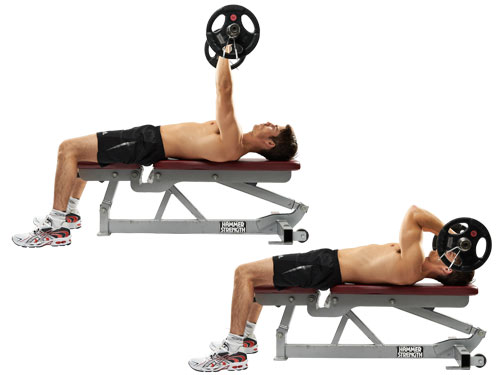
Lying Triceps Extensions 


Also known as 'skull-crushers', lying triceps extensions start with you lying flat on the bench with your arms straight up above you, perpendicular to your body. 


The exercise can be done with dumbbells, a straight bar, a cambered (EZ curl) bar or the specialized triceps bar. 


Start by slowly lowering the weight to your forehead then return it back to the top position at a faster speed. At the end of each set, go immediately into the next exercise with no break.

Narrow-Grip Bench Press 

The second half of this triceps superset is the narrow-grip bench press. 

If you're using a triceps bar then you'll automatically have a narrow grip already, but if not then be sure your grip is about shoulder width or a touch narrower. 

Going any narrower than that places too much strain on the wrists at the bottom of the movement, so if you find your wrists getting sore widen your grip slightly. Since you're already lying on the bench in the proper position, lower the weights to your chest while keeping your elbows tucked close to your body, then raise the weight directly up by extending your arms. 

Do not let your elbows drift out to the sides as this involves the pectoral muscles of the chest more than you want it to - keep the tension on your triceps as the weight moves up and down.

Because you're supersetting this press with the extensions the weight won't be as heavy as you could do otherwise, so you can compensate by either doing a few more reps per set or slowing each rep down, especially on the eccentric (lowering) portion of each rep.

At the end of your set rest for about a minute, then go back to the lying extensions to begin your next set. Perform the full cycle 3 - 4 times before moving on to the third exercise.

Overhead Triceps Extensions 

Sit up on your bench with your feet flat on the floor and a neutral or slightly-arched lower back. 

Using two hands, suspend a dumbbell overhead so that it rests perpendicular to the floor - your thumbs and forefingers should be wrapped around the handle while your palms and other fingers are pressed against the underside of the top bell to support the weight.

Keeping your elbows facing forward and tucked close to the sides of your head, bend your elbows and slowly lower the weight as far down as you can behind your head, then return the weight back up to directly overhead. 

Your upper arms should not move during the exercise but instead stay upright and close to your head.


Other Triceps Exercises 

The three exercises above will give you quick tricep workouts that are effective in building more muscle, but if you need to replace any of them due to injury or other physical issues, replace the necessary exercise with dumbbell kickbacks. 

Kickbacks have been shown to stimulate all 3 heads during each rep, so it's your best replacement exercise. 

Other triceps exercises like pushdowns, rope pushdowns, overhead cable extensions and triceps dips are good too, but save them for your workouts where time isn't limited and you can fit one or more of them in with these three.


Bigger biceps are a status symbol, a symbol of personal physical power, and every bodybuilder spends a fair amount of time working to achieve the best biceps they can build. Unfortunately time isn't always on our side, so for some workouts we need a quick bicep routine like this one...

Now, we don't want to take a lot of time, but we don't want to waste what little time we have either, right? So do a quick warmup set of curls if you haven't already warmed up your biceps while training other body parts. 

Don't overdo it - one set of 10 - 15 reps should suffice to get blood into the muscles and loosen up the joints, tendons and ligaments. Now choose a pair of dumbbells you can manage safely for 10 or 12 reps with strict form.

Note that these aren't reps you can cheat up with plenty of momentum and 'body English', but rather good, strict reps at a temp of 1 second up (concentric) and 3 - 5 seconds down (eccentric). 

For 2 of these 3 exercises you'll be taking body motion out of the equation entirely, so you need to choose weights that are challenging but manageable.

Do each of these three biceps exercises for 3 - 5 sets (depending on your available time), with 10 - 12 reps per set. Focus on keeping to your tempo, not trying to race through each set.

Incline Dumbbell Curls

Set the back of your bench to a 30 - 45 degree angle, then sit on the bench laying back against it with the dumbbells hanging at each side. 

Perform your curls through the full range of motion, finishing a full rep with one arm before repeating with the opposite arm. 

Keep your body flat on the bench throughout and don't let your elbows travel forward as you raise and lower the weights.

Dumbbell Scott Curls or Dumbbell Preacher Curls

Depending on the equipment you have available, you can do these as Scott curls or preacher curls. 

If neither bench is available, you can also stand behind an incline bench and rest the back of your upper arm down the padded back. 

Use a sitting or standing position that has you leaning forward from the waist with your armpit snug to the top of the pad. 

Resist the urge to lean backward as you raise the weights - the reason you're using the bench is to prevent yourself from 'cheating' the rep by involving your bodyweight. 

Curl the weight to the top, squeeze your contracted biceps hard for a second or two and then return it, under control, to the extended position.

Standing Dumbbell Curls

To finish off this quick bicep workout, use standing dumbbell curls. On the first exercise your elbow was behind the plane of your body while on the second it was ahead of your body, and this time you'll keep your elbows at your sides. 

Raise the weights one arm at a time, pronating your wrist at the top, rotating it to bring your baby finger closest to your chest & shoulder, before lowering it again at a controlled pace. Do not just let it drop back down, stick to the 3 - 5 second pace.

By the end of this quick bicep workout you should be able to tell the muscles have been well-worked, and flexing them should reflect a good pump. 

If timing is too tight even for this short routine, you can shorten it even further by doing one set of each exercise with no breaks in between, resting for one minute and then repeating the 3 sets until you've done your 3 - 5 cycles.

Either way, re-rack your dumbbells and smile - your biceps know they've had a great, fast workout!

By